Field notes / Event debrief
AmCham defence lunch, on the eve of Land Forces
I was at the AmCham defence lunch in Perth today, the day before Land Forces opens. Primes, startups, the US Embassy and the people who fund them, all in one room. Below is who spoke, what was covered, and why it might matter for you. I hope you find it useful.

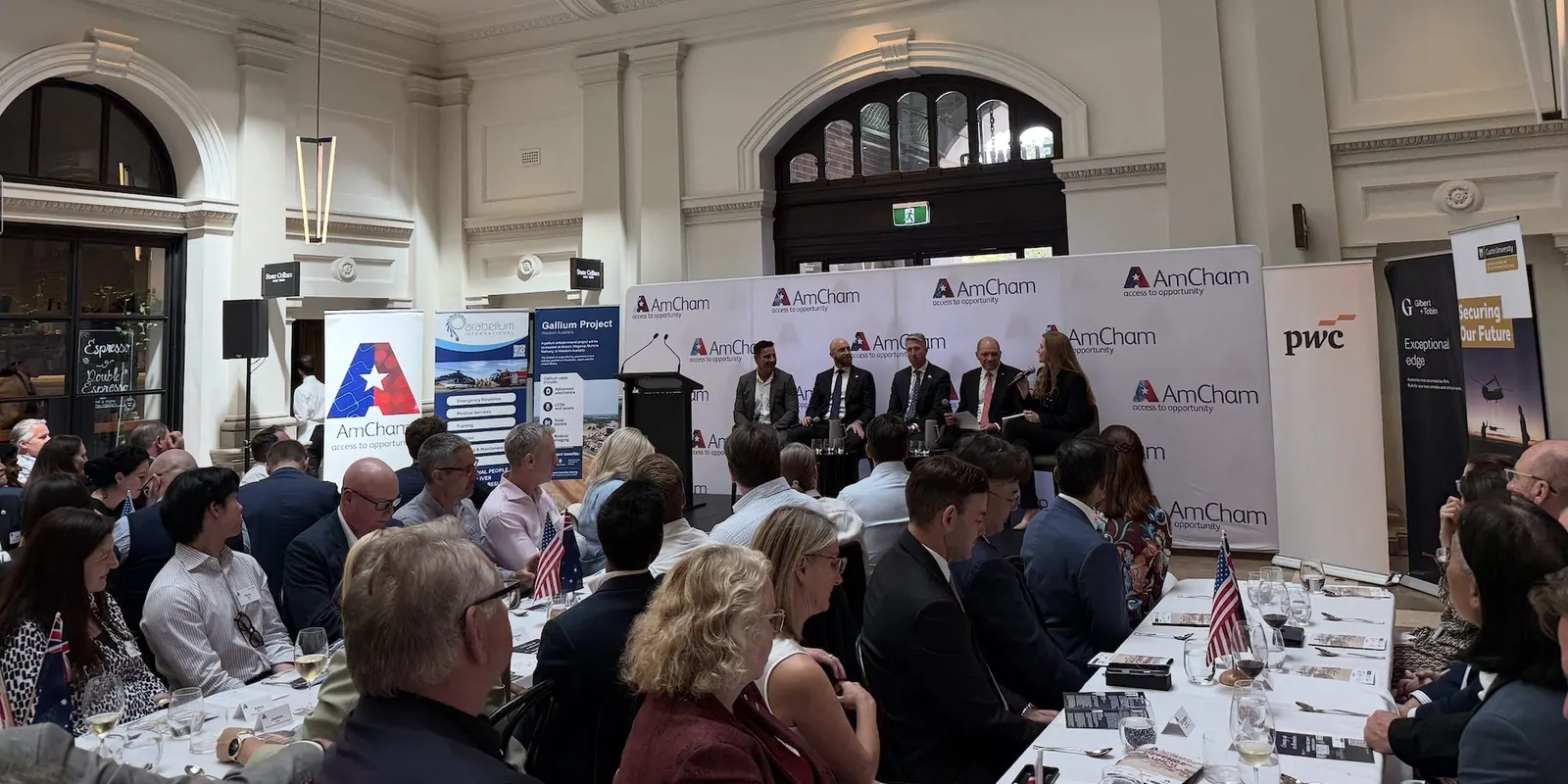
AmCham Defence Lunch / Perth / 5 October 2026
Who spoke
| In speaking order | Role | Talk to them about | Connect |
|---|---|---|---|
| Natalie Meyer | General Manager, WA and NT, AmCham Australia | AmCham WA, US delegations | |
| Robert Koepcke | Deputy Chief of Mission, US Embassy Canberra | US advocacy, market entry | Embassy profile |
| Elsabe Muller | President, Alcoa Australia | Critical minerals supply | |
| Jessica Keogh | Chief Operating Officer, Parabellum International | WA defence services | |
| Paddy Gregg | Managing Director and CEO, Austal | Austal's supply chain | |
| James Keane | Co-founder and CEO, Greenroom Robotics | Maritime autonomy partners | Website |
| Mark Bennett | Chief Growth Officer, Camgian (US) | US AI partnering | |
| David Goodrich OAM | Executive Chairman and CEO, Anduril Asia-Pacific | The Ghost Shark supply chain |
What was covered, and what it means for you
-
01
Back yourself
David Goodrich
Anduril put $60 million into its Ghost Shark factory 18 months before it had a contract. Then it signed a $1.7 billion firm fixed-price, firm fixed-time deal. No progress claims, no cost-plus, and the unit price to the Commonwealth falls as volume rises. For you: Price certainty is a position. If you can quote a fixed price, or show your unit cost falling with volume, lead with it. Buyers remember the company that takes the risk off them.
-
02
The supply chain is the door
David Goodrich · Paddy Gregg
42 Australian SMEs sit inside the Ghost Shark supply chain, and Anduril has funded some of them to make them resilient. Austal said the supply chain needs continuity as much as the shipbuilder does, and it already builds submarine modules in Alabama for the US. For you: For most SMEs, the way in is a prime that needs you to keep pace. Name the two or three primes whose delivery you make easier, and pitch the problem you solve for them, not your product.
-
03
Capital
David Goodrich · James Keane
Asked if Australia has the capital to scale its companies, the answer was a clear no. Anduril has raised about US$13.5 billion in nine years in US markets. The advice was to set up a US entity, raise there and bring it home. Greenroom bootstrapped for eight years and came out capital efficient. For you: Decide early whether a US structure is part of your raise.
-
04
Critical minerals
Elsabe Muller
Alcoa has started building its gallium plant in Western Australia, backed by Australia, Japan and the US. For you: Allied governments are co-funding supply chains. If your product depends on a constrained material, that belongs in your story.
-
05
Autonomy and AI
James Keane · Mark Bennett
Close the trust gap by putting regulators and assurance teams inside the design process. Rapid test and evaluation builds a data flywheel for assurance and product at once. Humans stay in the loop on lethal decisions. For you: The risk buyers fear is unproven capability. Keep a running record of every trial, test and result, and put it in front of them before they ask.
-
06
The US wants to hear from you
Robert Koepcke · Natalie Meyer
Ambassador David Brat is now in place, focused on commercial diplomacy, critical minerals and AUKUS. Every US Embassy and Commerce official in the room was asked to stand up and be found. For you: If the US is on your plan, they want the good, the bad and the ugly. Use them as advocates.
-
07
What everyone agreed on
Full panel
Government needs to send a bolder demand signal, and long-dated contracts unlock people and factories. Australia should be self-reliant in maritime, weapons and rare earths. Hiring is not the problem, mission and culture are. AUKUS Pillar 2 has more room for SMEs than Pillar 1, and less funding. For you: If you're in maritime, weapons or rare earths, say so in your first line. If you're not, show which of them you serve.
Where your category showed up
| If you build | Where the demand was named | Start with |
|---|---|---|
| Maritime autonomy, uncrewed | Ghost Shark, smart shipping, seabed survey, the crewing gap | James, David |
| AI, C2, kill chain | Sensor to effector automation with humans in the loop | Mark |
| Critical minerals, materials | Gallium, and rare earths named as a sovereign must | Elsabe, US Embassy |
| Shipbuilding, manufacturing | Henderson, digital shipyard tools, cobots, US submarine modules | Paddy |
“Sheds don't build ships.”
My take
One of the things that stood out to me most today was David Goodrich's point about his supply chain. 42 Australian companies are inside one programme because a prime backed itself and needed partners who could keep up.
For most founders I work with, that's the way in. A prime with a delivery problem will move faster than a tender. Your job is to make it easy for them to say yes. Know which programme you fit, what you replace, and what it costs at volume. If they have to work that out themselves, they won't.
Having trouble marketing yourself? We should talk
A growth practice for frontier tech. Recognise this? The Diagnostic scores where your story loses people.
Get Field Notes by email
One short piece a fortnight on positioning and go-to-market for frontier tech. No spam. Unsubscribe anytime. Privacy policy.
Thanks. Field Notes will come to that address.